Insights

Vasile Fana
I have something very exciting that I recently experienced and wanted to share with the industry. Though there is nothing official from Salesforce on this yet, I know the gap is closing. How do I know? I worked with the Salesforce product team to make it happen faster.
As we've been pioneering the implementation of the new Digital Insurance and Claims Management products released on the Salesforce core platform, we've encountered many challenges, one of which was quite untraditional. The customer wanted to sell different products via the same channel. These products were different in every aspect: price model, taxation and even the delivery model were all completely different. This was not a nice-to-have requirement; this has been the foundation of our architecture requirements from day one. The products were designed for self-service, related to one another and in some cases dependent on each other. This reflects the increasing need for a customer-centric platform. In our case, the customer was providing warranty products alongside professional services, merchandise and other add-on products. Products that needed to be quoted for together and delivered via their own channels. This can be solved by implementing different platforms and integrating the CX layer. But is there another way to achieve this in the current day and age?
Well, the way Salesforce is reshuffling its product stack, with CPQ reaching its end of sale and Industries CPQ components made available on Agentforce Revenue Management (ARM), the future looks very interesting. Is Salesforce redesigning its platform for coexistence? What is the value in product coexistence?
Well, here are some thoughts that will help you find your own answers:
Products on core become catalysts. As more of these products and features are moved to core, they become enablers and make things more accessible and flexible for development. Managed packages are restricted by design, and from a development perspective that is not always something you can extend and adapt to your exact needs. Not to mention that some managed packages come with unresolved bugs that lived for 5+ years. Now, with their capability migrated to the core platform, we have more access, context and even documentation on these features. Also, the features and outcomes on the core platform are more predictable than the old Vlocity packages.
Coexistence of products. Providing that all the capability resides in the same platform, you can easily have coexisting products and teams on the same platform, and provide more customer value by meeting their needs with more complex and bundled products that may cross one market or even industry. This is quite revolutionary, as products usually drive very different operations. Sales must be appropriately qualified, coverages require underwriting, loans require onboarding and KYC, service agreements require SLAs and contracts, and so on. So the challenge goes well beyond coexistence and sales, but the demand is there.
Streamlining development and internal operations. Providing that data residency is not a concern, platforms can be merged together to simplify business operations and platform governance, and enable new revenue streams. With an increasing need for self-service via new platforms, and new requirements driven by the agentic era, businesses need to meet customer needs with customer-centric solutions.
And this is not just an idea. I hear these requirements from customers, and challenges across consultants and product enablement teams. A brokerage that sells carrier warranties and wants to supply its maintenance plans, other add-on products and related services. Or a lending company that wants to sell a fully secured loan, or offer related products and services that could benefit a borrower. There are quite a few examples like these across the industry.
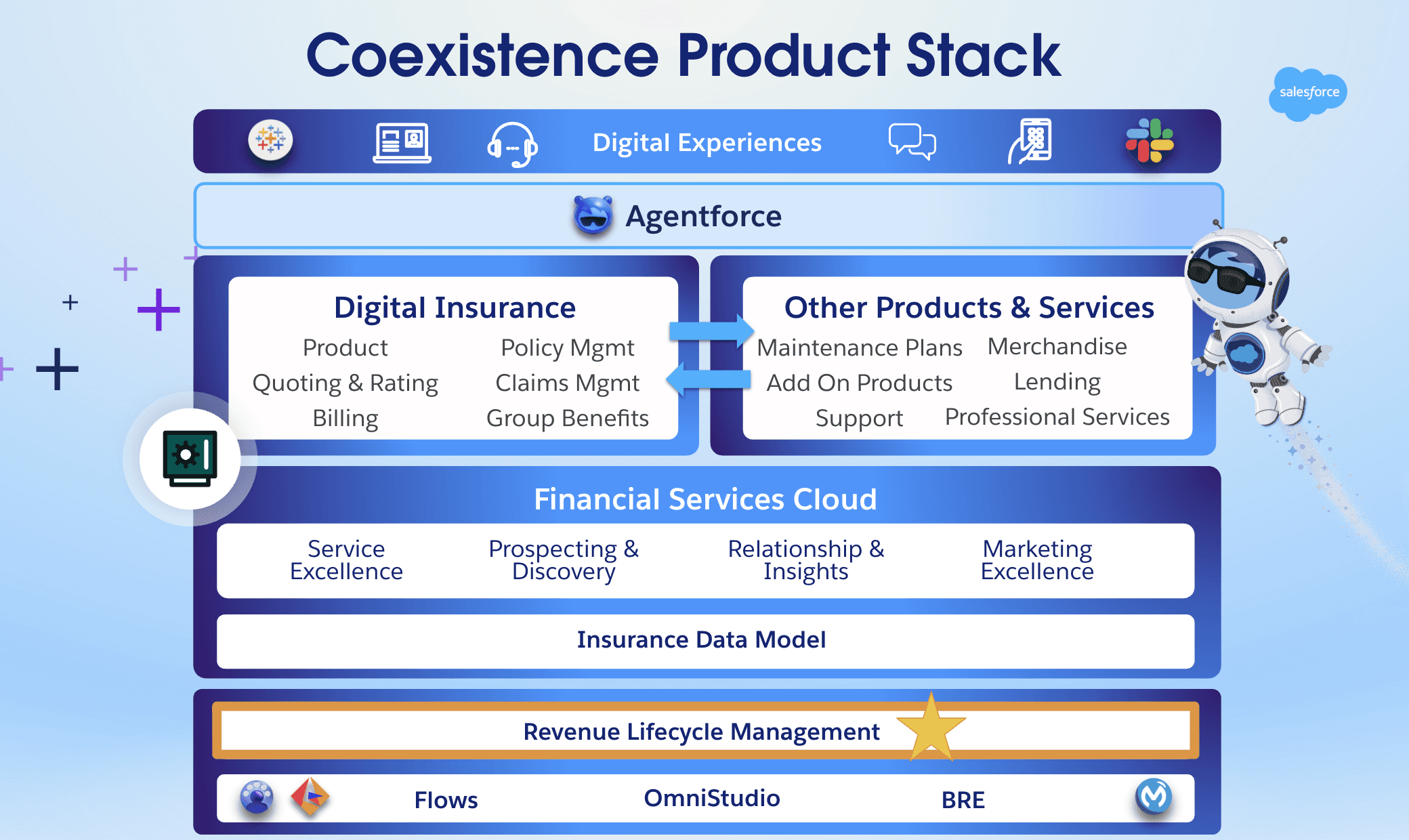
I have borrowed and adjusted this product tech stack to showcase the new ARM capability (formerly Revenue Lifecycle Management), the industry-standard data model, and the add-on features and components available with different industry products, all enabled on the same platform and externalized via Digital Experiences across channels. We're yet to see this full stack in practice. Conceptually it makes sense, and technically some aspects are already possible, but there's no official release date from Salesforce yet. Current coexistence documentation only covers Vlocity and FSC capability on the same platform. This article is well beyond that ask.
Further reading (official Salesforce sources):